
Buying a used injection molding machine: the whole path, from choosing to production
What a used machine is, and where it comes from
An injection molding machine melts plastic granules and injects them under pressure into a mould. Almost every moulded plastic object — closures, housings, crates, bumpers — comes off one. A new machine is a two-to-four month lead time and a capital decision; a good used machine of the same tonnage is a fraction of the price and can be in your plant within weeks.
Used machines reach the market three ways, and the route matters more than most buyers realise:
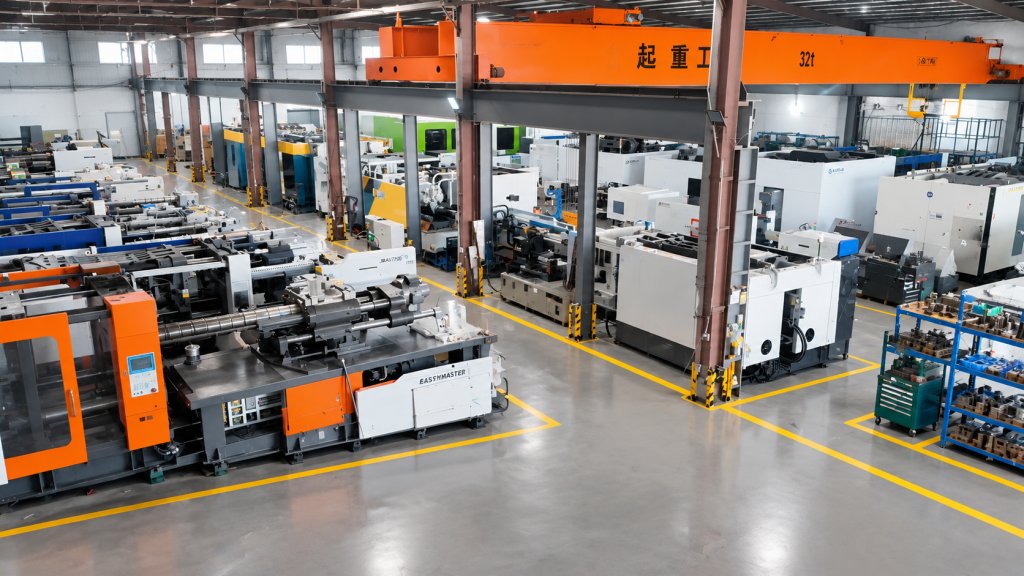
- Upgrade retirements. A working factory replaces a machine that still runs, usually to gain servo efficiency or a bigger clamp. These are normally the best-maintained machines on the market, because someone was depending on them last week.
- Plant closures and relocations. Whole-shop liquidations. Condition varies enormously and machines may have sat idle for months — long enough for seals to dry out and hydraulic oil to absorb water.
- Lease returns. Well documented, often with a service history, but frequently high-hour.
Two levels of preparation are sold. An as-is machine is cleaned, tested and sold as it stands. A refurbished machine has wear parts replaced, hydraulics resealed, paint made good and the machine re-tuned; expect to pay 10–20% more for it. Which is right depends on whether you have maintenance capability in-house.
Ask where a machine came from. It is a fair question and the answer tells you a lot. A machine retired from a running production line has a very different history from one recovered out of a closed plant.
Used versus new: the arithmetic
| New machine | Recent-year used | |
|---|---|---|
| Purchase price | Full list | Typically 30–50% of new for a machine three to five years old |
| Lead time | 2–4 months from order | In stock; loaded within weeks |
| Capability | Reference | A recent servo machine performs close to new for general moulding |
| First-years depreciation | The steepest period is yours | Largely absorbed by the first owner |
| Warranty | Manufacturer warranty | Seller warranty only, on defined components — read what it covers |
The blunt version: for a given budget, buying used usually lets you step up a tonnage class, or buy a second machine. For a plant with orders ramping and cash flow that is not, that is the fastest route to capacity there is.
Used is not right for everything. Optical parts, thin-wall high-cavitation work, medical mouldings under a validated process and anything needing all-electric repeatability are cases where a new machine earns its price. For general industrial and consumer mouldings — which is most of the market — a good used machine is more than enough.
The real risk in a used machine is not its age. It is the seller. Which is why sections 6 and 7 — how to inspect, and how to structure the payment — are the heart of this guide.
Choosing tonnage
Clamping force is the single most consequential specification. Too little and the mould flashes or will not fill; too much and you have paid for capacity you now heat, power and maintain forever. The working rule:
Required clamping force (t) ≈ projected area (cm²) × material factor (0.3–0.7 t/cm²)
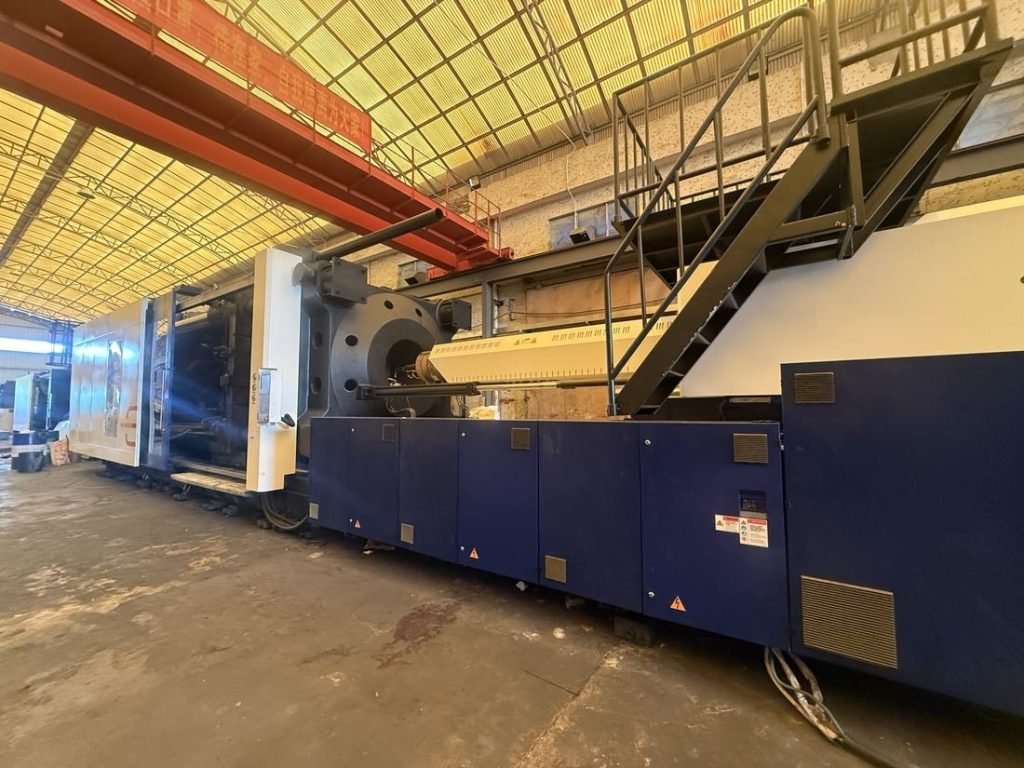
- Projected area is the shadow the part casts in the mould-opening direction. Multiply by the number of cavities and add the runner system.
- The factor follows how easily the material flows: free-flowing PP, PE and PS take 0.3–0.45; ABS around 0.45–0.55; stiffer-flowing PC and PA 0.55–0.7. Thin walls and long flow paths push you to the top of the band.
- Add 10–20% margin — for process drift, for a future part, and because a machine running at 95% of its clamp all day is a machine wearing out its toggles.
Worked example: a stacking chair projects roughly 1,600 cm². In PP at 0.35 that is 560 t; with margin, a 650 t machine is the safe buy.
| What you are moulding | Suggested clamping force |
|---|---|
| Closures, cutlery, small housings, precision small parts | 90–160 t |
| Small appliance housings, small automotive parts, PET preforms | 160–250 t |
| Crates, helmets, medium housings | 320–470 t |
| Chairs, large appliance housings, larger automotive parts | 650–800 t |
| Pallets, bins, bumpers, large industrial mouldings | 1000 t and above |
Do not calculate it alone if you are unsure. Send a photograph of the part with its weight and material and we will size it — free, and with no obligation. We do this most weeks.
Choosing the model
Within a tonnage class, three things separate machines: the drive, the clamp architecture, and the controller generation.
- Servo versus fixed-pump hydraulic. A servo drive turns the pump only as fast as the moment demands, instead of running flat out and dumping the surplus over a relief valve. Energy savings of 30–60% against an old fixed-pump machine are realistic, and where industrial electricity is expensive this alone can decide the purchase.
- Toggle (three-platen) versus two-platen. Toggle clamps dominate below about 1,000 t: fast, cheap to maintain, well understood. Above that, two-platen designs take 20–30% less floor length, give a longer mould-opening stroke and hold clamping force more evenly across a large platen.
- Controller generation. An older controller is not a fault, but check that its display, keypad and I/O cards are still obtainable. A machine whose controller is unobtainable is a machine with a hard end-of-life.
Whatever the badge, the practical questions are the same three: can I buy parts for it locally, can I hire someone who knows it, and will it resell. A machine that scores well on those three is worth paying a little more for.
Year, hours, and a machine’s real age
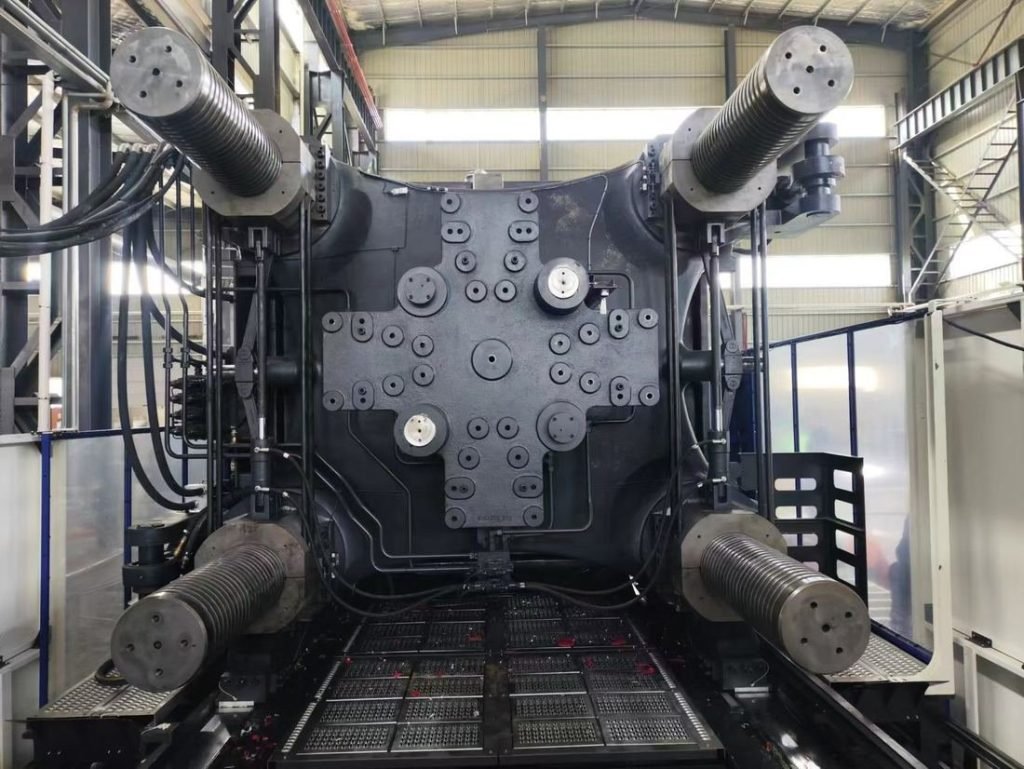
- Year of build. On the machine plate, alongside the serial number. Photograph both. A plate can be swapped; a serial number can be checked against the manufacturer’s records, which is why the serial belongs in your contract.
- Running hours. The controller logs total run time. As a reference, a machine in full three-shift production accumulates roughly 6,000–7,000 hours a year. Hour meters on used machines are frequently unreliable and are sometimes reset — treat the figure as one data point, not as fact.
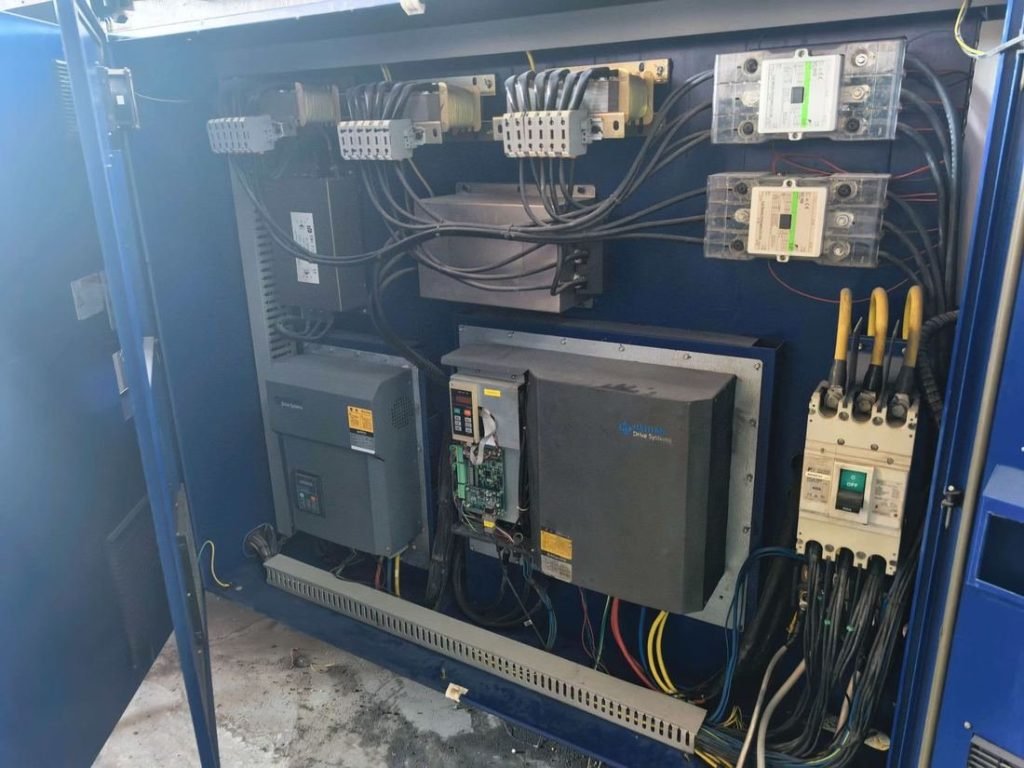
- The places that do not lie. Date codes on the contactors and relays inside the electrical cabinet. The condition of hydraulic hose fittings and crimps. Wear polish on the tie-bars and guide rails. Paint can be renewed in a week; those three cannot.
A repainted machine is not a dishonest machine. But a machine that has been repainted, whose hour meter reads implausibly low, with ten-year-old date codes in the cabinet, is telling you something. Ask for the cabinet on camera.
Inspection: six systems, and what to insist on
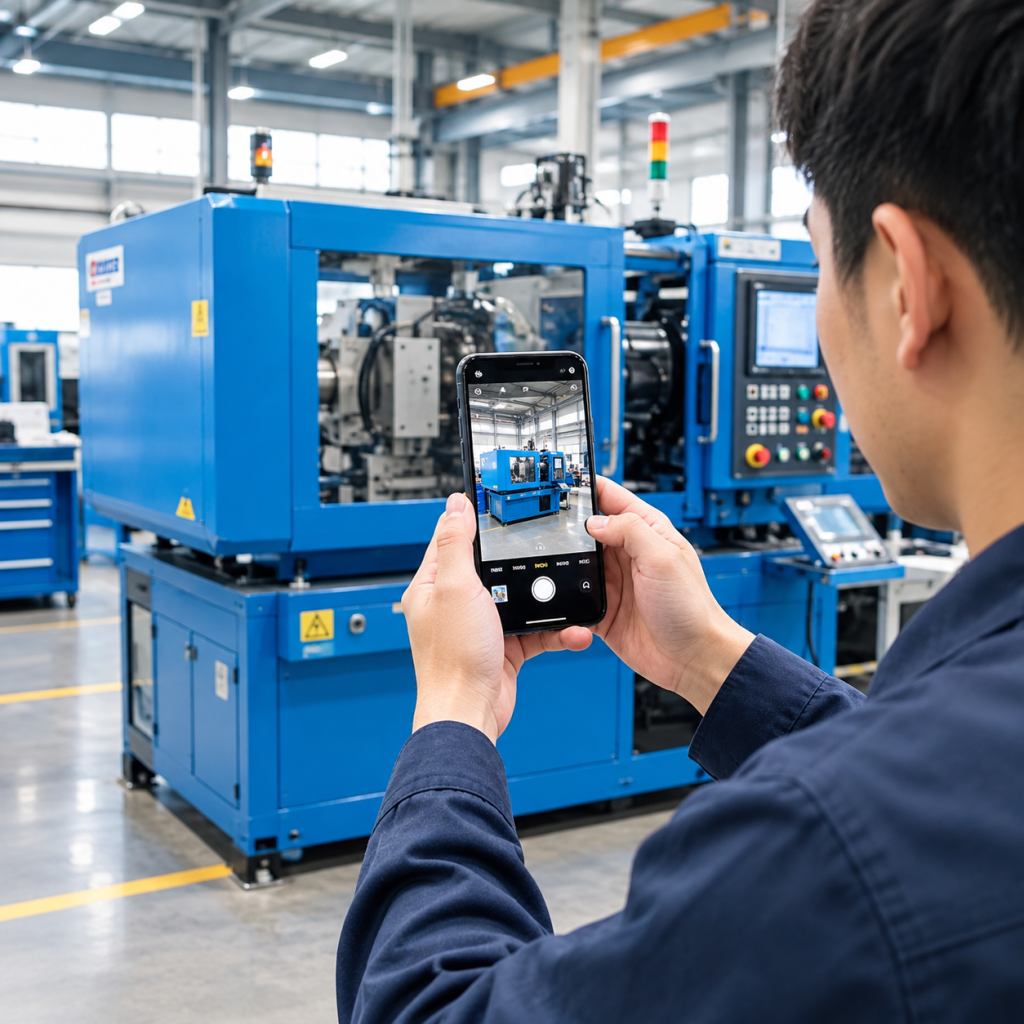
Work this list on any machine, from any seller, and you avoid most of what goes wrong. Every item below can be covered on a video call; for a large order, add a physical or third-party inspection on top.
- Appearance and structure. No impact damage or weld repair on the frame. Tie-bars and rails bright, without deep scoring or rust pitting.
- Clamping system. Ask for platen parallelism to be measured with a dial gauge and the number reported — out-of-parallel platens destroy moulds. Toggle motion smooth and quiet; ejector reaching position and returning cleanly.
- Screw and barrel. The most expensive wear pair on the machine. Flight crests should not be rounded, pitted or corroded. Ask for the measured screw-to-barrel clearance: beyond roughly 0.8–1% of screw diameter it needs replacing. Insist on a number, not “good condition”.
- Hydraulics. Oil level and colour — dark or cloudy oil means poor maintenance. No weeping at cylinders, valve blocks or fittings. Oil temperature settling at 40–55 °C after half an hour running.
- Electrical and drive. Alarm history on the controller, not just the current screen. Servo motor starting, stopping and changing speed without squeal or judder. Cabinet wiring factory-tidy, with no improvised splices or heat marks.
- Test run. See it under power through several complete cycles. Shot-to-shot weight drifting more than about ±0.5% means wear is already affecting production. Ask for maintenance records, and be suspicious of a machine that keeps having the same component replaced.
You do not have to remember all of it. Book a video inspection and we will put the camera on every item above, in this order. This is exactly why inspecting before paying is possible at all.
Avoiding fraud: it is the payment structure, not your instincts
Nearly every cross-border used-equipment fraud fails on the same point: money paid in full before anyone saw the machine. Avoiding it is not a matter of judging character. It is a matter of structure.
- Inspect first, pay after. A seller who will not open a video call on the machine, or let you visit, has ended the conversation for you.
- Split the payment. A deposit reserves the machine; the balance falls due only after the pre-shipment check passes. Refuse to pay in full up front, from anyone.
- Check the goods before releasing the balance. Do it yourself on video, or appoint SGS, Bureau Veritas or your own forwarder. A seller who resists this is telling you what the machine looks like.
- Verify the payee. The receiving account name must match the seller company named in the contract. “Please pay our finance manager’s personal account” is where you stop.
- Put it in writing. Model, serial number, year, full configuration list, refurbishment scope, warranty terms and default liability. Verbal promises are not terms.
Our seven-step process exists to make this structure the default rather than something you have to negotiate: inspection, optional visit, contract and deposit, refurbishment, pre-shipment check, balance, loading. Your money has an exit at every step before the last.
Refurbishment and reconfiguration
The window between the deposit and shipping is the cheapest time in the machine’s life to change anything about it. Once it is in a container the same work costs several times as much.
- Standard refurbishment. Seals, hydraulic oil, filters and batteries replaced; full clean and service; re-test under power.
- Screw and barrel. A different screw type, or a material-specific screw for PET, PVC or filled compounds. T-slots cut where your tooling needs them.
- Attachments. Robot interface, mould temperature controller, drying hopper, auto-feeder — fitted and tested together, so the line runs on arrival rather than after a second procurement round.
- Voltage and frequency. Adapted to your grid (380 V / 415 V / 440 V, 50 or 60 Hz). Discovering a mismatch after the container is opened is a common and entirely avoidable delay.
Get every item onto the configuration list before you sign. The pre-shipment check verifies the machine against that list — anything not on it is not being checked, and is not owed to you.
Sea freight, documents and country rules
Injection molding machines classify under HS heading 8477.10. The standard document set is the commercial invoice, packing list, bill of lading and certificate of origin; some destinations add an inspection certificate.
- Up to roughly 250 t: often one or two machines in a 40 ft container.
- 320–800 t: usually one machine per 40 ft container; hopper, guards or the safety gate may come off to make height.
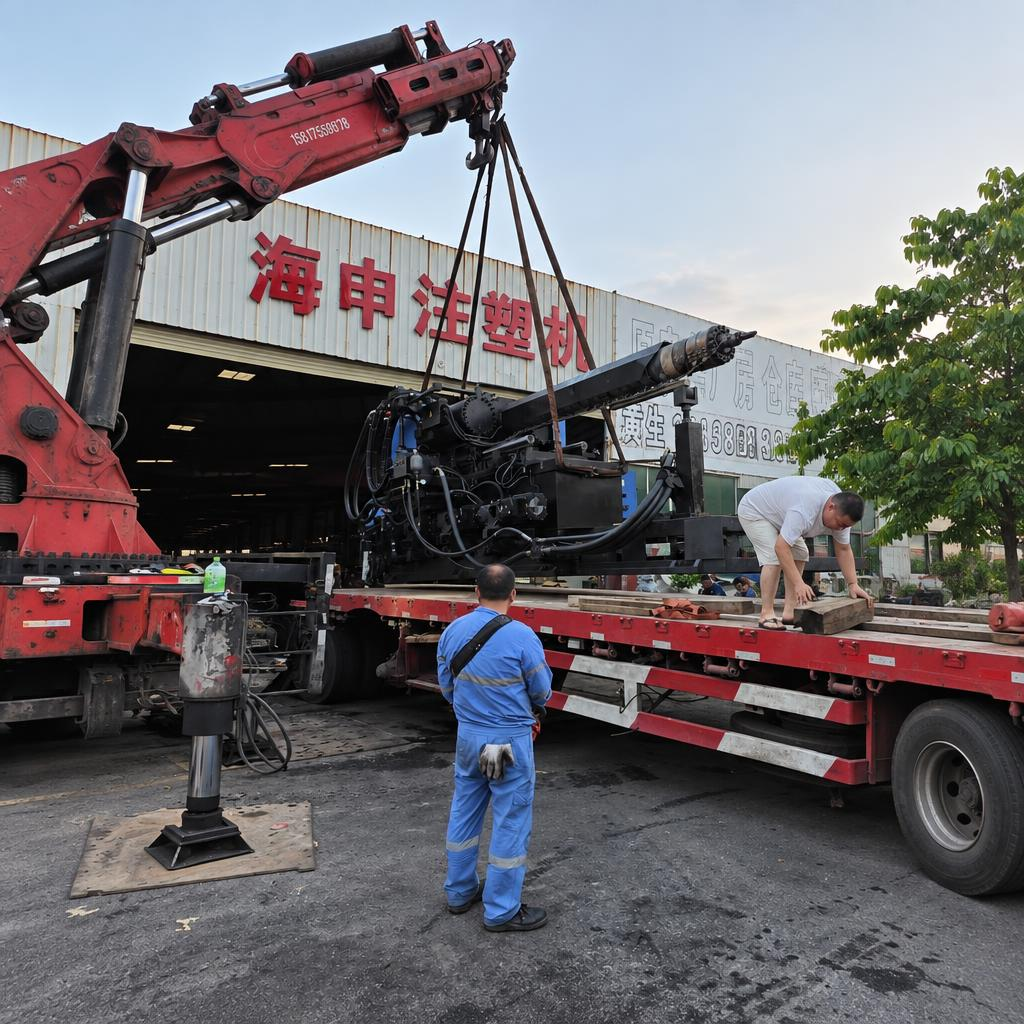
- Above about 1,000 t: broken down — clamping unit, injection unit and cabinet packed separately — on a flat rack or break bulk, with assembly guidance on arrival.
- Packing: waterproof film and stretch wrap, loose electrical parts in ISPM15-compliant fumigated crates, steel-wire bracing inside the container.
| Destination | The rule that decides it | What to check before paying |
|---|---|---|
| Vietnam | Used machinery must be under ten years old (Decision 18/2019/QD-TTg), with a conformity inspection | Year on the machine plate, and that it still qualifies on the arrival date |
| Indonesia | Used capital goods (BMTB) require an import approval and a pre-shipment inspection by an appointed surveyor | That the permit is in hand before the machine ships, not after |
| India | A Chartered Engineer Certificate is required; no strict age cap | Who issues the CEC and that it is issued before shipment |
| Elsewhere | Rules vary — some markets have age caps, some require inspection, some neither | Ask your customs broker in writing before the deposit |
Rules change. Everything above is a starting point for a conversation with your own customs broker, not a substitute for one. Confirm the current requirement in your country before you pay a deposit, and get the confirmation in writing.
What it actually costs, delivered
The workshop price is the largest line but never the only one. Total landed cost is:
machine price (EXW) + inland haulage and export declaration + sea freight + duty and VAT + port handling and lifting + installation and commissioning
Price within a tonnage class is driven by year, hours, drive type, controller generation and condition — a recent servo machine and a decade-old fixed-pump machine of the same clamping force are not in the same market. As indicative bands for recent-year used machines, EXW China:
| Clamping force | Indicative used market band (USD, EXW) |
|---|---|
| 90–160 t | Low five figures |
| 200–320 t | Low-to-mid five figures |
| 380–470 t | Mid five figures |
| 650–800 t | High five figures |
| 1000 t and above | Six figures, quoted case by case |
Those bands are a sense of scale, not a quotation: they move with year, condition, configuration and the market. Current prices for machines we actually hold are on the machine pages.
Sea freight for a single container to South-East Asia is commonly in the low thousands of dollars, more to India, the Middle East and Latin America. Many countries apply a reduced duty rate — occasionally zero — to production equipment, so check the tariff line for 8477.10 with your broker rather than assuming the general rate.
Ask for a landed figure, not a machine price. Send us your destination port and we will quote the machine with freight, and flag the duty position, so nothing turns up as a surprise at the port.
Installation and first start
- Foundation. Build the level foundation and anchor pockets to the foundation drawing before the machine arrives. For medium and large tonnage an anti-vibration trench is worth the money.
- Lifting. Hoist only from the marked lifting points. Never let slings bear on the rails, the tie-bars or the oil lines.
- Services. Confirm voltage and phase sequence before energising. Keep mould cooling water and oil-cooler water on separate circuits.
- Levelling. Level the frame with a precision level. A machine that is not level wears its rails and clamping mechanism at a rate you will notice.
- First start. Check the oil level, grease rails and tie-bars, run dry at low speed for half an hour, then mount a mould and trial.
Call before you improvise. Remote video support during commissioning costs nothing and prevents the two or three mistakes that turn a good machine into a warranty argument.
Frequently asked questions
I do not really understand machines. Can you help me choose?
Yes, and it is a routine part of the job. Send a photograph of the part, its weight and the material on WhatsApp. We calculate the clamping force from the projected area, then put two or three machines from stock in front of you with price, year, hours and real photographs. Sizing advice is free and carries no obligation to buy.
Can I see the machine running before I pay anything?
Yes — that is the whole basis of how we sell. A live video inspection happens before any deposit, on as many machines as you want to compare, and you keep the recording.
How many more years will a used machine last?
A well-maintained injection molding machine has a working life measured in decades, not years; the honest answer depends on hours, duty cycle and how it was looked after, not on age alone. What matters more is whether wear parts and controller components remain obtainable — which is why parts availability appears in every section of this guide.
What warranty comes with a used machine?
Whatever the contract says, and nothing else. Read the covered component list, the period, and how a claim is actually handled — parts shipped, an engineer, or a video call. A used machine does not carry a manufacturer warranty, and any seller implying otherwise should be asked to put it in writing.
Who pays the freight, and roughly how much?
It depends on the incoterm you agree. EXW means you arrange everything from our door; CIF means we quote the machine delivered to your port. Freight for a single 40 ft container is commonly in the low thousands of dollars to South-East Asia and rises with distance. Tell us your port and we will put a figure in the quotation.
Is my country allowed to import used machinery at all?
Most are, but the conditions differ sharply — age caps, pre-shipment inspection, import permits, engineer certificates. Section 9 lists the common ones. Confirm the current rule with your own customs broker in writing before paying a deposit; regulations change and the importer carries the consequence.
Who handles installation and commissioning after arrival?
Local rigging and electrical connection are arranged at your end — any competent industrial contractor can do it from the foundation drawing. We provide the drawings, the commissioning sequence and remote video guidance while you run it up.
Where to check the rules yourself
Import rules change, and no supplier’s summary is a substitute for the primary source. Verify with your own customs broker and with the issuing authority in your country before you commit money. For the destinations covered above, the relevant instruments are Vietnam’s Decision 18/2019/QD-TTg on used machinery imports, Indonesia’s import approval regime for used capital goods (BMTB), and India’s Chartered Engineer Certificate requirement under its used-machinery import policy.
Finished reading? The next step is small
Send the part you are moulding and the destination port. We come back with what is actually in stock, and a video of it running — before anything is committed.
Book a video inspection